Oi Oi She at It Again Girl
| Io | |
|---|---|
 Io wearing bovine horns watched over by Argos on Hera's orders (1st century AD) at Naples National Archaeological Museum, Naples, Italy | |
| Abode | Argos Egypt |
| Personal information | |
| Parents | Inachus Melia |
| Consort | Zeus Telegonus |
| Children | Keroessa Epaphus |
Io (; Ancient Greek: Ἰώ [iːɔ̌ː]) was, in Greek mythology, i of the mortal lovers of Zeus. An Argive princess, she was an ancestor of many kings and heroes, such equally Perseus, Cadmus, Heracles, Minos, Lynceus, Cepheus, and Danaus. The astronomer Simon Marius named a moon of Jupiter subsequently Io in 1614.
Because her brother was Phoroneus, Io is also known every bit Phoronis (an adjective course of Phoroneus: "Phoronean").[1] She was sometimes compared to the goddess Isis, whereas her Egyptian married man Telegonus was "Osiris".[two] [3]
Family [edit]
In most versions of the fable, Io was the daughter of Inachus,[4] [5] though various other purported genealogies are also known. If her father was Inachus, then her mother would presumably have been Inachus' wife (and sister), the Oceanid nymph Melia, daughter of Oceanus.[6] The 2nd century Advertising geographer Pausanias also suggests that she is the daughter of Inachus and retells the story of Zeus falling in love with Io, the legendary wrath of Hera, and the metamorphosis by which Io becomes a beautiful white heifer.[7] At another instant several generations later, Pausanias recounts another Io, descendant of Phoroneus, daughter of Iasus,[8] who himself was the son of Argus and Ismene, the girl of Asopus,[9] or of Triopas and Sosis; Io's mother in the latter case was Leucane.[10] Io's father was called Peiren in the Catalogue of Women,[eleven] and by Acusilaus,[12] possibly a son of the elder Argus, likewise known equally Peiras, Peiranthus or Peirasus.[13] [14] Io may therefore be identical to Callithyia, daughter of Peiranthus, equally is suggested by Hesychius of Alexandria.[15]
Mythology [edit]

Io and Zeus [edit]
Io was a priestess of the Goddess Hera in Argos,[5] [16] whose cult her father Inachus was supposed to take introduced to Argos.[5] Zeus noticed Io, a mortal adult female, and lusted later on her. In the version of the myth told in Prometheus Bound she initially rejected Zeus' advances, until her father threw her out of his house on the advice of oracles.[17] According to some stories, Zeus then turned Io into a heifer (a moo-cow) in order to hibernate her from his married woman;[5] others maintain that Hera herself transformed Io.[17] [18]
In the version of the story in which Zeus transformed Io, the deception failed, and Hera begged Zeus to give her the heifer every bit a present, which, having no reason to refuse, he did. Hera then sent Argus Panoptes, a behemothic who had 100 optics, to watch Io and foreclose Zeus from visiting her, and then Zeus sent Hermes to distract and eventually slay Argus. According to Ovid, he did so past starting time lulling him to slumber by playing the panpipes and telling stories.[nineteen] Zeus freed Io, withal in the grade of a heifer. In some myths, Hera uses Argus' eyes to decorate her peacock's feathers to give thanks the giant for his help.

In order to exact her revenge, Hera sent a gadfly to sting Io continuously, driving her to wander the world without rest. Io eventually crossed the path between the Propontis and the Blackness Bounding main, which thus acquired the name Bosporus (meaning ox passage), where she met Prometheus, who had been chained on Mt. Caucasus by Zeus. Prometheus comforted Io with the information that she would exist restored to human being form and become the ancestress of the greatest of all heroes, Heracles (Hercules). Io escaped across the Ionian Sea to Arab republic of egypt, where she was restored to homo course by Zeus. There, she gave birth to Zeus's son Epaphus, and a girl as well, Keroessa. She afterwards married Egyptian king Telegonus. Their grandson, Danaus, somewhen returned to Greece with his l daughters (the Danaids), as recalled in Aeschylus' play The Suppliants.
The myth of Io must have been well known to Homer, who often calls Hermes Argeiphontes, which is often translated every bit "Argus-slayer", though this interpretation is disputed by Robert Beekes. Walter Burkert[20] notes that the story of Io was told in the ancient epic tradition at least iv times of which nosotros have traces: in the Danais, in the Phoronis—Phoroneus founded the cult of Hera, according to Hyginus' Fabulae 274 and 143—in a fragment of the Hesiodic Aigimios, also as in similarly fragmentary Hesiodic Catalogue of Women. A mourning celebration of Io was observed at the Heraion of Argos into classical times.
The ancients connected Io with the Moon,[21] and in Aeschylus' Prometheus Leap, where Io encounters Prometheus, she refers to herself as "the horned virgin". From her relationship with Phoroneus, equally sister (or descendant), Io is sometimes called Phoronis.[22]
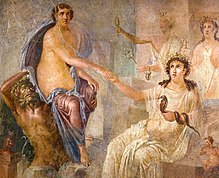
Io and Isis. Antique fresco from Pompeii.
Io every bit Isis [edit]
Ligdus and his wife, Telethusa, were a poor couple living in Crete.[23] When Telethusa became pregnant, her husband told her that they can't afford having a daughter, and that they take no other option than to impale the child if information technology would be a daughter. 8 months subsequently Io, afterward in the story mentioned as Isis, came in a vision to Telethusa telling her that she should keep her daughter when it'south built-in and must tell her married man that it's a boy named Iphis.
Later in the story, Isis (Io) changes Iphis' sex when she is supposed to marry her fiancée, Ianthe.
| |||||||||||||||||||||||||||||||||||||||||||||||||||||||||||||||||||||||||||||||||||||||||||||||||||||||||||||||||||||||||||||||||||||||||||||||||||||||||||||||||||||||||||||||||||||||||||||||||||||||||||||||||||||||||||||||||||||||||||||||||||||||||||||||||||||||||||||||||||||||||||||||||||||||||||||||||||||||||||||||||||||||||||||||||||||||||||||||||||||||||||||||||||||||||||||||||||||||||||||||||||||||||||||||||||||||||||||||||||||||||||||||||||||||||||||||||||||||||||||||||||||||||||||||||||||||||||||||||||||||||||||||||||||||||||||||||||||||||||||||||||||||||||||||||||||||||||||||||||||||||||||||||||||||||||||||||||||||||||||||||||||||||||||||||||||||||||||||||||||||||||||||||||||||||||||||||||||||||||||||||||||||||||||||||||||||||||||||||||||||||||||||||||||||||||||||||||||||||||||||||||||||||||||||||||||||||||||||||||||||||||||||||||||||||||||||||||||||||||||||||||||||||||||||||||||||||||||||||||||||||||||||||||||||||||||||||||||||||||||||||||||||||||||||||||||||||||||||||||||||
| Colour key: Male person | |||||||||||||||||||||||||||||||||||||||||||||||||||||||||||||||||||||||||||||||||||||||||||||||||||||||||||||||||||||||||||||||||||||||||||||||||||||||||||||||||||||||||||||||||||||||||||||||||||||||||||||||||||||||||||||||||||||||||||||||||||||||||||||||||||||||||||||||||||||||||||||||||||||||||||||||||||||||||||||||||||||||||||||||||||||||||||||||||||||||||||||||||||||||||||||||||||||||||||||||||||||||||||||||||||||||||||||||||||||||||||||||||||||||||||||||||||||||||||||||||||||||||||||||||||||||||||||||||||||||||||||||||||||||||||||||||||||||||||||||||||||||||||||||||||||||||||||||||||||||||||||||||||||||||||||||||||||||||||||||||||||||||||||||||||||||||||||||||||||||||||||||||||||||||||||||||||||||||||||||||||||||||||||||||||||||||||||||||||||||||||||||||||||||||||||||||||||||||||||||||||||||||||||||||||||||||||||||||||||||||||||||||||||||||||||||||||||||||||||||||||||||||||||||||||||||||||||||||||||||||||||||||||||||||||||||||||||||||||||||||||||||||||||||||||||||||||||||||||||||
Gallery [edit]
-
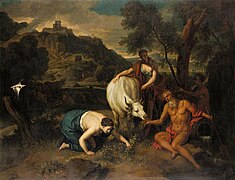
Io Recognised by Her Father by Victor Honoré Janssens (second half of 17th century)
-
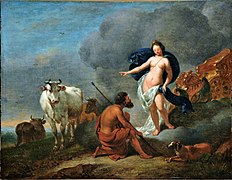
Hera and Io by Nicolaes Pietersz. Berchem the Younger (circa 1669)
-

Jupiter and Io by John Hoppner (1785) at Denver Fine art Museum
-

From Neueröffneter Musen-Tempel by Bernard Picart, (1733) from University of Heidelberg
-

Juno (Hera) commits Io to Argus Panoptes by Francesco de Mura (1740–1750) at Museum of Modern and Gimmicky Art of Trento and Rovereto, Italy
-
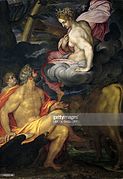
Jupiter, Juno and Io past Giovanni Ambrogio Figino (1599) at Pinacoteca Malaspina Parent institution Musei Civici, Pavia
-
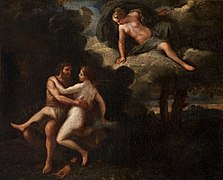
Jupiter and Io, espied by Juno by Andrea Sacchi and Pier Francesco Mola (1600 - 1699) at Kedleston Hall, Derbyshire (Accredited Museum)
-
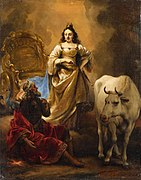
Juno, Jupiter and Io by Gerbrand van den Eeckhout
-

Jupiter, Juno and Io past Arnold Houbraken
-
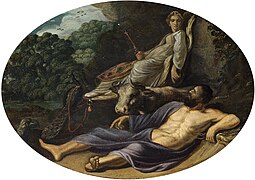
Jupiter and Io by Jacob Pynas at The Fitzwilliam Museum, U.k.
-

Io et Jupiter past Antonio da Correggio at Musée Ingres, Montauban
-
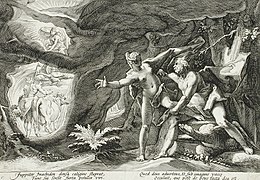
Jupiter and Io by Hendrik Goltzius (1589) at Los Angeles Canton Museum of Art, Los Angeles
Notes [edit]
- ^ Lewis & Brusque. A Latin Dictionary.
Phŏrō-nis, ĭdis, f. adj., Phoronean, poet. for Argive [...] Subst. : Phorōnis, ĭdis, f., Io
- ^ Lemprière, John (1809). A Classical Dictionary. D. & G. Bruce. p. 355.
Afterwards she married Telegonus, rex of Egypt, or Osiris, co-ordinate to others, and she treated her subjects with such mildness and humanity, that afterwards death, she received divine honours, and was worshipped under the name of Isis. [...] She is sometimes chosen Phoronis, from her blood brother Phoroneus.
- ^ Beauzée, Nicolas (1751). L'Encyclopédie (in French).
On a étendu encore plus loin la signification de ce terme, & l'on appelle noms patronymiques, ceux qui sont donnés d'après celui d'un frere ou d'une sœur, comme Phoronis, c'est-à-dire Isis Phoronei soror .
Summary/translation: "The term patronymic was expanded even further to include those named after a sibling, such as Phoronis to mean Isis, the sis of Phoroneus." - ^ Aeschylus, Prometheus Spring, 590; Apollodorus, Bibliotheca, two.1.3; Herodotus, Histories, 1.one; Ovid, Metamorphoses, 1.583.
- ^ a b c d Hammond, edited by N. G. L.; Scullard, H. H. (1970). The Oxford Classical Lexicon (2nd ed.). Oxford [Eng.]: Clarendon Press. p. 549. ISBN0198691173.
- ^ For Melai as wife of Inachus meet Apollodorus, Bibliotheca, 2.i.i
- ^ Pausanias, Description of Greece, i.25.ane
- ^ Pausanias, Clarification of Greece, 2.16.i
- ^ Apollodorus, Bibliotheca, 2.1.3.
- ^ Scholia on Euripides' Orestes, 932
- ^ Catalogue of Women. fr. 124
- ^ Apollodorus, Bibliotheca, ii.one.3; Acusilaus, fr.12
- ^ Thousand.L. W, The Hesiodic Catalogue of Women: Its Nature, Structure, and Origins (Oxford, 1985) 77
- ^ Pausanias, Description of Greece, 2.i.3; Hyginus, Fabulae, 124.
- ^ Hesychius of Alexandria s. v. Ὶὼ Καλλιθύεσσα
- ^ Apollodorus, Bibliotheca, 2.1.3
- ^ a b Howatson, M.C. L.; Chivers, I. (1993). The Oxford Curtailed Companion to Classical Literature. Oxford [Eng.]: Clarendon Press. pp. 288–9. ISBN0192827081.
- ^ Aeschylus, Suppliant Women, 291
- ^ Ovid, Metamorphoses, I.650-730
- ^ Burkert, Human being Necans (1974) 1983:164 note fourteen, giving bibliography.
- ^ Eustathius of Thessalonica commentary on Dionysius Periegetes, 92; the Byzantine encyclopedia Suda s.v. "Io", Hesychius, s.v. "Io".
- ^ Tsagalis, p. 409, Peck, p. 200; east.g. Ovid, Metamorphoses 1.668, 2.524.
- ^ Ovid Metamorphoses. volume 9, poetry 666-797.
References [edit]
- Ovid. Metamorphoses, Volume I: Books 1-viii. Translated by Frank Justus Miller. Revised by G. P. Goold. Loeb Classical Library No. 42. Cambridge, Massachusetts: Harvard Academy Press, 1916. Online version at Harvard Academy Press.
- Peck, William Thane (editor), The First and Second Books of Ovid'south Metamorphoses, Ginn & Visitor, 1900.
- Tsagalis, Christos, Early Greek Epic Fragments I: Antiquarian and Genealogical Epic, Walter de Gruyter GmbH & Co KG, 2017. ISBN 9783110532876
External links [edit]
- Theoi.com: Io: naiad nymph of Argolis and Egypt Assembles the essential references in Greek and Latin literature, in translation.
- Io engravings by Goltzius from the De Verda collection
- Warburg Institute Iconographic Database (ca 250 images of Io and Argus)
allensoutimseling99.blogspot.com
Source: https://en.wikipedia.org/wiki/Io_(mythology)
0 Response to "Oi Oi She at It Again Girl"
Post a Comment